
When spray coating is the right process
Spin coating is efficient on flat, rotating substrates. Deep cavities, high steps, vertical sidewalls, microchannels and complex three-dimensional surfaces require a different approach. Spray coating controls droplet formation, nozzle distance, scanning path and the number of coating passes to build coverage across these features.
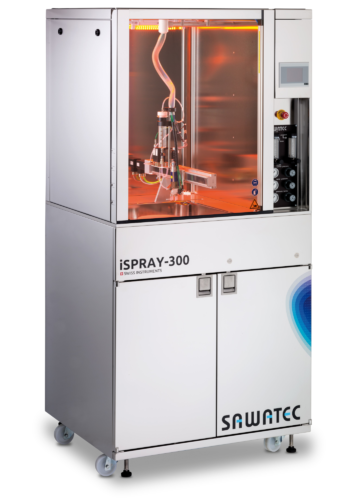
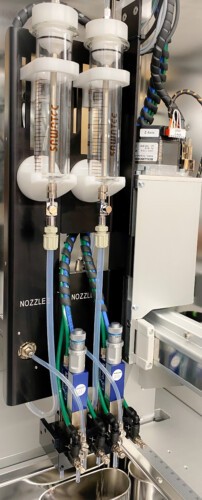
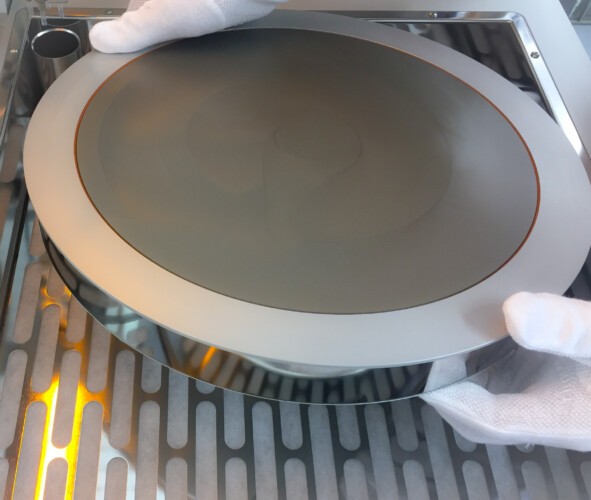
iSPRAY-300 process configuration
| Item | Configuration or range | Why it matters |
|---|---|---|
| Substrate range | Up to 300 mm wafers or 12 × 12 inch substrates | Round and square substrates |
| Coating material viscosity | 0.3–25 cSt | Confirm with resist, dilution system and target film thickness |
| Spray-arm motion | Motorized x/y axes and automatic z-axis nozzle-distance adjustment | Controls path, speed and working distance |
| Nozzle options | Micro 3/3, 3/4 and 3/5; optional second nozzle | Matches material, droplet formation and coverage target |
| Temperature option | Heated chuck up to 150°C, Ø300 mm | Supports evaporation, film formation and multilayer programs |
Typical non-planar coating tasks
Deep cavities and high steps
Nozzle distance, scanning speed, angle and multiple passes can be evaluated for top, bottom and sidewall coverage.
MEMS and microfluidics
Photoresist coating for trenches, microchannels, sensor structures and other non-planar substrates.
Advanced packaging and RDL
Complex topography around bumps and redistribution-layer processes should be configured from the actual geometry and material.
Six inputs needed before configuration
Geometry
Step height, cavity depth, sidewall angle, opening size and aspect ratio.
Substrate
Round, square or irregular shape, dimensions, thickness, warpage and batch size.
Material
Resist type, solids content, solvent system, viscosity and safety requirements.
Coverage target
Required thickness at the top, bottom and sidewall, including acceptable variation.
Nozzle and feed
Single or dual nozzles, liquid switching, automatic cleaning and material consumption.
Temperature and automation
Heated chuck, FFU and a possible path into ROBO or cluster integration.
For automated wafer photoresist spray coating, SAWATEC lists the iSPRAY-200-CS module in the 200 mm CS-200-4 pioneer manufacturer listing and the iSPRAY-300-CS module in the 300 mm CS-300-4 orbiter manufacturer listing. Confirm the wafer size, resist and throughput when selecting the cluster configuration.
Choose between spin and spray coating from the surface
Flat wafers and conventional film targets should first be evaluated with a spin coater. Complex three-dimensional topography should start with a spray-coating trial. The final process should be based on the real sample, material, coverage result and throughput.
Start with the sample geometry
Send the substrate drawing or cross-section, photoresist, target coverage, present defects and throughput. These inputs narrow the nozzle, path, liquid-feed and temperature configuration.
Contact SAWATEC China Deep-cavity and sidewall process guide →