
1. Freeze the measurement method first
Use the same instrument, calibration, point map, edge exclusion, substrate orientation and calculation method for every comparison. Record the raw thickness map, not only the summary percentage. If the map changes when the substrate is rotated relative to the metrology tool, investigate the measurement setup before changing the coater.
| Record | Why it matters |
|---|---|
| Average thickness and all point values | Distinguishes a global thickness shift from local non-uniformity |
| Point coordinates and edge exclusion | Prevents two different maps from being compared as one metric |
| Instrument, recipe and calibration | Separates process movement from metrology movement |
| Substrate orientation | Helps identify fixed equipment, substrate or measurement patterns |
2. Classify the observed pattern
Radial pattern
Check dispense position and volume, acceleration, final speed and time, material temperature, exhaust and evaporation boundary.
Azimuthal pattern
Check substrate centering, chuck contact, local airflow, nozzle path, bowl condition and substrate asymmetry.
Random or drifting pattern
Check bubbles, material age and temperature, line condition, environmental drift, contamination and measurement stability.
3. Lock the material condition
Record material lot, storage, time out of storage, working temperature, viscosity at a stated temperature, filtration, container pressure and line purge. A change in viscosity or solvent condition can shift both average thickness and spreading behavior. Do not compensate an uncontrolled material state only by changing spin speed.
Precision dispensing and liquid-delivery inputs →
4. Verify dispense before speed
Observe initial wetting, dispense position, nozzle height, dose repeatability, bubbles and coverage before the high-speed step. Static center dispense is not automatically suitable for square, irregular or large substrates. Dynamic or multi-position dispense may be evaluated when the starting liquid distribution is the limiting factor.
5. Change one recipe group at a time
Separate the spread step, acceleration transition, final spin and deceleration. Keep material, substrate and environment fixed while changing one group. Save the recipe version and raw map for each trial. A faster final speed may reduce average thickness without correcting a systematic airflow, wetting or dispense problem.
6. Check substrate and chuck interaction
Confirm flatness, warpage, backside particles, vacuum support, centering and whether the chuck masks or distorts part of the sample. For fragile, thin, perforated or non-standard substrates, chuck design can affect both mechanical stability and coating behavior.
7. Control exhaust and chamber boundary
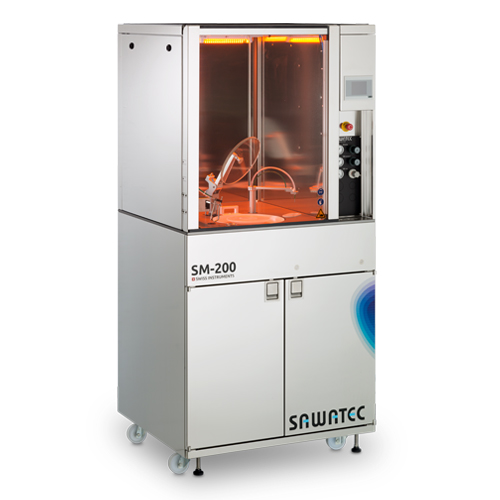
Record exhaust setting, room airflow, bowl cleanliness and lid or chamber condition. The SAWATEC RCCT approach provides a more controlled coating boundary than an open process region, but improvement for a specific material and substrate must still be demonstrated with a controlled comparison. No fixed uniformity or material-saving percentage should replace sample testing.
8. Separate coating from bake effects
If thickness or optical response is measured after bake, also freeze bake temperature, contact mode, time, loading delay and cooling conditions. A coating map can be altered by non-uniform solvent removal or thermal history after spin.
Precision hotplates and bake modules →
Controlled trial sequence
- Freeze material lot, temperature, substrate preparation and metrology.
- Repeat the current recipe to establish within-run and run-to-run variation.
- Verify dose, wetting and coverage before changing the speed program.
- Change one variable group and retain every raw map and defect image.
- Repeat the best candidate across multiple substrates before accepting the result.